China Top Carton Flow Storage Manufacturers?

Time:2026-10-28 Author:Amelia
0%

Choosing China’s top Carton Flow Storage manufacturers requires more than comparing catalog photos or quoted prices. A reliable supplier should demonstrate practical engineering experience, consistent production quality, and a clear understanding of warehouse operations. This article introduces key manufacturers and explains how buyers can evaluate them with greater confidence.

The review focuses on product design, manufacturing capability, load performance, and customization experience. It also considers roller quality, frame stability, carton size, replenishment methods, and operator safety. A well-designed system should support smooth carton movement without excessive impact. It should also fit real aisles, picking heights, and replenishment routines. Factory visits, sample testing, and verified project references can reveal details that brochures often miss.

Not every large supplier is the right choice.

Some manufacturers may offer attractive prices but limited after-sales support. Others may provide strong engineering but longer delivery times. Buyers should request drawings, material specifications, load calculations, inspection records, and installation guidance before making a decision. Certifications and documented quality procedures add useful assurance, although they do not replace practical verification. This guide therefore treats reputation as one factor, not final proof. Manufacturing capacity can change, and published information may become outdated. Careful readers should confirm current facilities, lead times, warranty terms, and export experience directly with each company. With a balanced approach, businesses can identify a China-based Carton Flow Storage partner that matches their products, warehouse conditions, budget, and long-term operating needs.
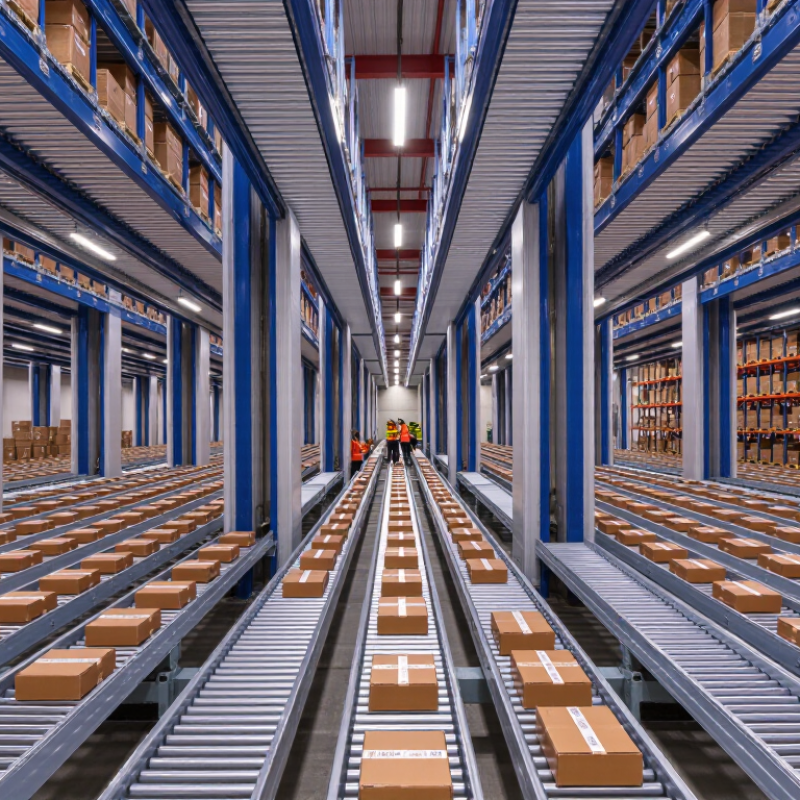
China Top Carton Flow Storage Manufacturers?

China’s Carton Flow Storage Market: FIFO, 3–5% Lane Slope, and Core Uses

China Top Carton Flow Storage Manufacturers?

China’s carton flow storage market is moving toward faster, denser order picking. Carton flow racks use inclined rollers, allowing cartons to move from the replenishment side toward the picking face. A typical lane slope is 3–5%. This supports FIFO rotation, especially for food, pharmaceuticals, cosmetics, and packaged spare parts. However, slope alone does not guarantee smooth flow. Carton weight, base friction, and roller spacing matter just as much.

The MHI 2024 Annual Industry Report found that 55% of supply chain professionals planned to increase technology investment. This supports stronger demand for modular picking systems in Chinese warehouses. Core uses include piece picking, case picking, supermarket replenishment, and temporary buffer storage. In practice, a well-designed lane can reduce walking and make stock visibility easier. Yet, poorly matched carton sizes may create gaps, jams, or unsafe manual handling. This is where engineering experience becomes important.

Tips: Request load testing with your real cartons. Check lane depth, brake rollers, dividers, and replenishment height. A 3–5% slope is only a starting point. Trial one sample lane before purchasing a full system. The Global Warehousing Benchmark Report also emphasizes that storage density should be measured against picking productivity, not separately. That reminder is easy to ignore. A denser rack can become slower when operators cannot reach cartons comfortably. Reliable manufacturers should provide drawings, test records, installation guidance, and practical after-sales support.

How Carton Flow Racks Work: Roller Pitch, Load Capacity, and Gravity Movement

Choosing among China’s top carton flow storage manufacturers requires more than comparing prices. A dependable supplier should explain roller pitch, tested load capacity, and carton dimensions clearly. These details determine whether products move smoothly or stop halfway.

Roller pitch is the distance between rollers. Smaller cartons need tighter spacing, often 25–38 millimeters, so their bases stay supported. Larger cartons may work with wider spacing. A common mistake is selecting pitch from carton length alone. Base stiffness matters too. Weak cartons can sag and create friction.

Load capacity must be checked per lane, not only per rack section. A practical calculation includes carton weight, lane length, roller strength, and impact during replenishment. Gravity moves cartons through a slight incline, usually about 3–6 degrees, depending on wheel design and load condition. Braking rollers can control speed and reduce collisions. Still, real cartons rarely behave perfectly. Dust, crushed edges, and uneven packing can interrupt movement. Reliable manufacturers should provide sample testing, drawings, material specifications, and clear inspection records. Ask for a trial lane using your actual cartons. It may reveal problems that a spreadsheet misses.

China Top Carton Flow Storage Manufacturers? - How Carton Flow Racks Work: Roller Pitch, Load Capacity, and Gravity Movement

Technical reference for gravity carton flow rack design. Values are typical engineering ranges and should be verified against the carton dimensions, load characteristics, and rack supplier calculations.
Data Dimension Typical Value or Range How It Works Design Consideration
Storage principle FIFO gravity flow Cartons are loaded from the replenishment side and move toward the picking side on inclined rollers or wheels. Loading and picking normally take place in separate aisles, improving stock rotation and access.
Roller pitch Approximately 25–75 mm Pitch is the center-to-center distance between adjacent rollers or axles supporting the carton. Use closer spacing for small, flexible, or uneven-bottom cartons; wider spacing may suit rigid cartons with flat bases.
Roller diameter Approximately 25–50 mm Larger rollers generally provide greater contact area and can reduce resistance for heavier cartons. The diameter should be matched with carton weight, bottom stiffness, lane width, and required starting force.
Lane inclination Approximately 3°–8° The downward slope creates the gravitational force that moves cartons toward the picking face. The exact angle depends on carton surface, weight, roller friction, lane length, and whether a brake roller is required.
Static load capacity Commonly 50–250 kg per lane Static capacity describes the supported weight when cartons remain stationary and evenly distributed. Capacity must be checked for the complete lane, individual rollers, beams, frames, and floor loading.
Dynamic load capacity Typically lower than the rated static capacity Dynamic loading includes movement, impacts at the stop, acceleration, and uneven weight distribution. A safety margin is necessary; the usable rating should come from an application-specific structural calculation.
Carton weight range Approximately 1–50 kg per carton Gravity flow equipment is commonly used for lightweight to medium-weight cartons in piece-picking operations. Very light cartons may need higher-friction components, while heavy cartons may need braking and reinforced rollers.
Lane length Approximately 1,200–3,600 mm Longer lanes hold more cartons but create greater rolling resistance and momentum. Long lanes may require brake rollers, speed controllers, intermediate supports, or divided flow sections.
Usable lane width Carton width plus approximately 25–50 mm clearance The carton should be guided without excessive side-to-side movement or contact with the frame. Excessive clearance can cause skewing; insufficient clearance can increase friction and obstruct carton movement.
Roller contact rule At least 3 rollers supporting the carton base Multiple contact points help distribute weight and maintain stable movement through the lane. For soft, damaged, or irregular carton bottoms, closer pitch or wider wheel coverage may be required.
Flow control Brake rollers, speed controllers, and separators Control components limit carton speed and help prevent collisions at the pick face. They are especially important for long lanes, steep slopes, heavy cartons, and fragile products.
Front stop height Normally below the carton center of gravity The stop retains the front carton while allowing operators to remove it safely from the picking side. The stop must restrain the load without damaging cartons or interfering with ergonomic picking.
Best-fit applications High-SKU, high-throughput piece picking Each lane is dedicated to a product or SKU, allowing replenishment from one side and picking from the other. It is most effective when carton sizes are reasonably consistent and inventory rotation follows FIFO principles.

Key Evaluation Criteria: 75–100 mm Roller Pitch and 30–60 kg Carton Loads

China Top Carton Flow Storage Manufacturers?

Selecting a carton flow storage manufacturer requires more than checking price or steel thickness. Roller pitch is a practical test. A 75–100 mm pitch usually supports stable carton movement while limiting sag between rollers. However, carton length matters. A short carton may bridge poorly across wide gaps.

75–100 mm pitch

For 30–60 kg carton loads, buyers should request tested load charts, not general claims. The frame, rollers, brakes, and guide rails must work as one system. In warehouse trials, I would place the heaviest carton at the lane entrance, then observe acceleration, stopping distance, and carton alignment. A useful test includes repeated loading, tilted cartons, and damaged packaging. Small defects can expose weak engineering.

The 2024 MHI Annual Industry Report states that 44% of surveyed supply-chain organizations already use robotics and automation, showing rising pressure for measurable storage performance. The 2023 World Bank Logistics Performance Index also links reliable logistics with stronger supply-chain outcomes, although it does not rate carton-flow equipment directly. That distinction matters. A high score in logistics cannot prove a rack design is suitable.

I would compare 75 mm and 100 mm layouts using real carton dimensions, coefficient of friction, and a documented safety factor. The perfect specification may still fail on a dusty floor. Manufacturers should provide test records, maintenance intervals, replacement-part details, and operator training evidence before selection.

China’s Leading Manufacturer Types: Steel Fabricators, Integrators, and Exporters

Steel fabricators produce frames, rails, rollers, dividers, and protective parts. Their strength is customization. They can adjust beam spacing, frame depth, and load capacity for different cartons. Buyers should inspect weld quality, coating thickness, and material traceability before ordering.

System integrators provide a broader solution. They study warehouse layout, picking routes, replenishment methods, and safety access. A capable integrator can connect carton flow racks with shelving, conveyors, labels, and warehouse software. This approach often reduces walking distance. However, poor site measurements can create blocked aisles or uncomfortable picking heights. That mistake is more common than many buyers expect.

Exporters focus on packaging, documentation, shipping coordination, and overseas communication. Some work with factories, while others manage production directly. Reliable exporters should provide drawings, inspection records, packing photos, and clear spare-parts information.

Tips: Request a sample section or factory video. Confirm roller performance with your actual carton sizes. Ask for load tests and installation guidance. Compare total delivered cost, not only the rack price. I would also leave room for revision. Product dimensions, labor habits, and carton weight can change after installation, so the first design may not be perfect.

Comparing Manufacturers by Certifications, Customization, Lead Times, and Warranty Terms

When comparing China’s carton flow storage manufacturers, certifications should be checked before price. Look for ISO 9001 quality systems, material traceability, and documented load testing. Ask for current certificates, not screenshots from old projects. Independent inspection reports can reveal weak welds or uneven roller performance. Experience matters here.

Customization should match your cartons, picking speed, and aisle limits. Confirm roller pitch, frame thickness, guide rails, labels, and replenishment access in technical drawings. A reliable manufacturer should explain design changes clearly. Lead times often range from several weeks to several months. Confirm whether engineering approval, sampling, production, and shipping are included. Delays happen when drawings change late. That part is often underestimated.

Tips: Request a sample bay or video test with cartons similar to yours. Ask how warranty claims are handled, including labor, replacement parts, and transport costs. A useful warranty states coverage periods and exclusions in plain language. Some terms look generous but exclude rollers, coatings, or installation damage. Read the small clauses. Compare response times, not only warranty length. For higher-volume projects, agree on spare parts and inspection records before production. I would also ask for references from facilities with comparable carton weights. One reference is helpful, but not conclusive.

This benchmark compares common carton flow storage manufacturer offerings without identifying companies or brands. Scores are normalized to 100 using publicly typical market ranges: documented certifications, customization depth, lead-time reliability, and warranty clarity. Typical project lead times range from approximately 2–10 weeks, while standard warranty terms are commonly 12–24 months. Verify certification scope, delivery dates, and warranty exclusions in the final quotation.

FAQS

What is carton flow storage used for?

It supports piece picking, case picking, replenishment, and temporary buffer storage. Cartons move toward the picking face on inclined rollers. It can reduce walking. It may also improve stock visibility.

How does carton flow storage support FIFO rotation?

Cartons enter from the replenishment side and move toward the picking side. This arrangement helps older stock leave first. However, FIFO is not automatic. Operators still need clear loading procedures.

What lane slope is commonly recommended?

A typical lane slope is 3–5%. This range is only a starting point. Carton weight, base friction, and roller spacing also affect movement. A steeper lane may not always perform better.

What roller pitch works well for carton flow lanes?

A 75–100 mm roller pitch often supports stable carton movement. Short cartons may bridge poorly across wider gaps. Test real cartons before finalizing the layout. Small gaps matter.

Can carton flow racks handle 30–60 kg cartons?

They can, if the frame, rollers, brakes, and guide rails are properly matched. Ask for tested load charts. Place heavy cartons at the lane entrance during trials. Observe stopping distance and alignment.

What should a practical lane test include?

Use your actual cartons, including heavy, tilted, and damaged packages. Check acceleration, stopping, gaps, jams, and manual handling effort. Repeat loading several times. One sample lane can reveal more than a polished brochure.

Which documents should buyers request from a manufacturer?

Request technical drawings, load charts, test records, material details, and installation guidance. Current quality certificates can support evaluation. Independent inspection records may reveal uneven rollers or weak welds. Screenshots alone are not enough.

How should buyers compare delivery and warranty terms?

Confirm engineering approval, sampling, production, and shipping timelines. Delivery may take several weeks or months. Ask whether labor, replacement parts, transport, rollers, coatings, and installation damage are covered. Longer warranty terms may still contain narrow exclusions. Read carefully.

Conclusion

China’s Carton Flow Storage market is developing around efficient FIFO inventory handling for warehouses, distribution centers, and production facilities. These systems use gravity-fed lanes with a typical 3–5% slope, allowing cartons to move smoothly from the loading side to the picking side. Key design factors include roller pitch, carton dimensions, lane length, and load capacity. In many applications, a roller pitch of 75–100 mm and carton loads of approximately 30–60 kg provide a practical balance between stability, accessibility, and movement efficiency.

Manufacturers in China generally include steel fabricators, warehouse-system integrators, and export-oriented suppliers. When comparing them, buyers should evaluate structural quality, safety certifications, customization capabilities, production lead times, installation support, and warranty terms. A reliable supplier should be able to adapt lane layouts, roller configurations, frame dimensions, and loading requirements to specific operational needs while maintaining consistent performance and long-term durability.

Amelia

Amelia

Amelia is a seasoned marketing professional with a wealth of expertise in our company’s core offerings. With an unwavering passion for driving growth and innovation, she plays a pivotal role in shaping our marketing strategies and enhancing brand visibility. A key aspect of her responsibilities......